


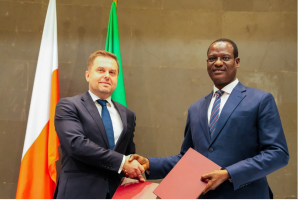
The Federal Government has called for a more ambitious Nigeria–Poland economic partnership focused on productive investment, industrial development, infrastructure financing and job creation, as both countries seek to translate longstanding diplomatic relations into tangible economic gains.
The Minister of Finance and Coordinating Minister of the Economy, Mr. Taiwo Oyedele, made the call on Tuesday at the Second Polish–Nigerian Economic Forum held in Lagos, where he outlined Nigeria’s investment opportunities and ongoing reforms to strengthen the country’s appeal as a destination for international capital.
Senior Special Assistant on Communications & Press Secretary to the Minister of Finance and Coordinating Minister of the Economy, Maryann Duke in a statement on Tuesday, said that delivering a keynote address entitled “Nigeria and Poland: Turning Partnership into Productive Investment,” the Minister said the relationship between both countries had considerable room for growth, noting that existing trade volumes remained modest relative to the size and economic potential of the two economies.
“In 2025, total bilateral trade stood at approximately $734 million, with more than 90 percent of Nigeria’s exports to Poland comprising crude oil. Mr. Oyedele said the priority should be to diversify this relationship towards higher-value trade, local processing, manufacturing, technology and services.
“He identified agriculture and food processing, energy, transport infrastructure, digital technology, manufacturing and healthcare as strategic sectors where Polish expertise, investment and financing could complement Nigeria’s development priorities.
“Drawing lessons from Poland’s economic transformation from a $67 billion economy in 1989 to one exceeding $1 trillion in 2025, the Minister highlighted the importance of sustained economic reforms, access to larger markets, export-oriented industrialization and strong financial institutions.
READ ALSO: EFCC arraigns Green City Financial MD, Amakwe Robert for alleged N5bn fraud
“He noted that Nigeria was pursuing a similar transformation through sustained policy reforms under President Bola Ahmed Tinubu, with the removal of the petrol subsidy and unification of the foreign exchange market providing the foundation for macroeconomic stability and renewed investor confidence.
“Providing an update on economic performance, Mr. Oyedele disclosed that Nigeria’s economy grew by 4.43 percent in the second quarter of 2026, while inflation had declined for several consecutive months, reaching its lowest level in six years in October. Foreign reserves also rose above $55 billion, while private capital inflows increased from about $300 million in 2023 to nearly $6 billion in 2026.
“He stressed that the next phase of the reform agenda must translate improved economic stability into productive investments, expanded businesses and employment opportunities at scale.
“As part of efforts to deepen investor participation, the Minister presented Projects Nigeria, the government’s investment deal room featuring 65 bankable, feasibility-backed projects valued at approximately $78.5 billion, with an estimated 366,000 jobs expected from their implementation.
“He invited Polish investors to explore the opportunities, particularly in infrastructure, power, agriculture, and manufacturing, noting that Nigeria’s position within the African Continental Free Trade Area gives investors access to a wider market of approximately 1.4 billion people.
“The Minister also highlighted the modernization of the Lagos Port Complex at Apapa and Tin Can Island as a significant example of the potential of Nigeria–Poland cooperation. The $1 billion project, supported by UK Export Finance, with Poland’s export credit agency, KUKE, reinsuring almost half of the financing, represents the largest sovereign export credit transaction in Nigeria since 2009 and KUKE’s first project in the country.
“He noted that modernising the ports would improve trade efficiency, reduce logistics costs, and strengthen Nigeria’s competitiveness, while showing how export credit agencies, development finance institutions, and commercial lenders could work together to mobilise financing for strategic infrastructure.
READ ALSO: EFCC arraigns lovers over alleged N178.2m theft in Lagos
“Welcoming the focus on blended finance and the proposed partnership between KUKE and the Africa Finance Corporation (AFC), Mr. Oyedele also acknowledged KUKE’s readiness to explore up to $2 billion in financing support for strategic projects in Nigeria.
“He, however, emphasised that access to financing must be matched by affordability, sound project economics and responsible debt management, particularly where foreign currency borrowing is involved in projects that generate revenue in naira.
“To translate the Forum’s discussions into concrete outcomes, the Minister proposed three priority actions: establishing a working-level engagement channel between the two finance ministries to follow up on investment opportunities; exploring co-financing arrangements between KUKE, BGK and Nigerian institutions, including the Bank of Industry and NEXIM Bank; and advancing discussions towards agreements on double taxation avoidance and investment protection to provide greater certainty for businesses in both countries.
“Mr. Oyedele further emphasised that successful partnerships must go beyond supplying equipment and financing to include technology transfer, skills development, local sourcing, and strengthening Nigerian businesses.
“The speeches and meetings are the fine passes. Let us come back with factories opened and people hired. Those are goals we can all celebrate.
“He reaffirmed the Federal Government’s commitment to building enduring economic partnerships that support private investment, expand productive capacity and create shared prosperity, assuring Polish businesses that Nigeria remained open to credible investors ready to build long-term value in the country.
“The Second Polish–Nigerian Economic Forum brought together government officials, financial institutions, export credit agencies, investors and private sector leaders from both countries to explore opportunities for stronger trade, investment and economic cooperation,” the statement added.